Skill Development Platform

Gleac is a skill assessment and development platform. In a candidate-short market with high levels of competition for top talent. It’s more important than ever to create a highly skilled workforce. Gleac helps business to upskill their workforce. I joined the Gleac team at a very early stage (Ideation Phase). My role was to collaborate with the founder to build a product from the ground up.

Note : Due to the confidentiality of this project, I cannot present the lot visuals or elaborate how does the product work. If you are interested in learning more about this project, feel free to contact me!

Project Type

Solo

Role

Research, ideation, UI and UX design.

Duration

Late 2019 (1 Month)

Creating a foundation

My role

I joined gleac team in 2018 my role was to act as a channel between all parts of the company to design the user experience. From working closely with the users(IT Employees) and founder to identify product opportunities, connecting with engineers to understand technical/hardware restraints, validating solutions, to checking in with support regularly to understand potential pain points among beta testers.

Discovery

Understanding the users

I conducted In-Depth Interviews (online) with 8 participants. The criteria for participants that I looked for are those who can still be said to be of productive age (18–30 years) and are currently working and trying to upskill. The research objectives that I define are:

  • Discover participants’ mental models, including their goals/motivation and behavior when improving their skill/competence.
  • Identify participants’ pain points when improving their skill/competence.

Understanding the company

Then I interviewed two business co-founders about the process of assigning courses to employees and the challenges they face in the process.

Findings

The interview began with a question about how the participant’s experience in learning new skill and their pain points. Here are some quotes from the participant’s answer that I got from the interview:
“My skills are still lacking and not sure what course should I take to improve”
“I don’t know what skill I’m lacking and I have no idea how to find it”
“I struggle to find the time, and I want to study at my own pace.”
“I don’t prefer learning from pre-made materials as they are not tailored to my specific needs.”

Affinity Mapping

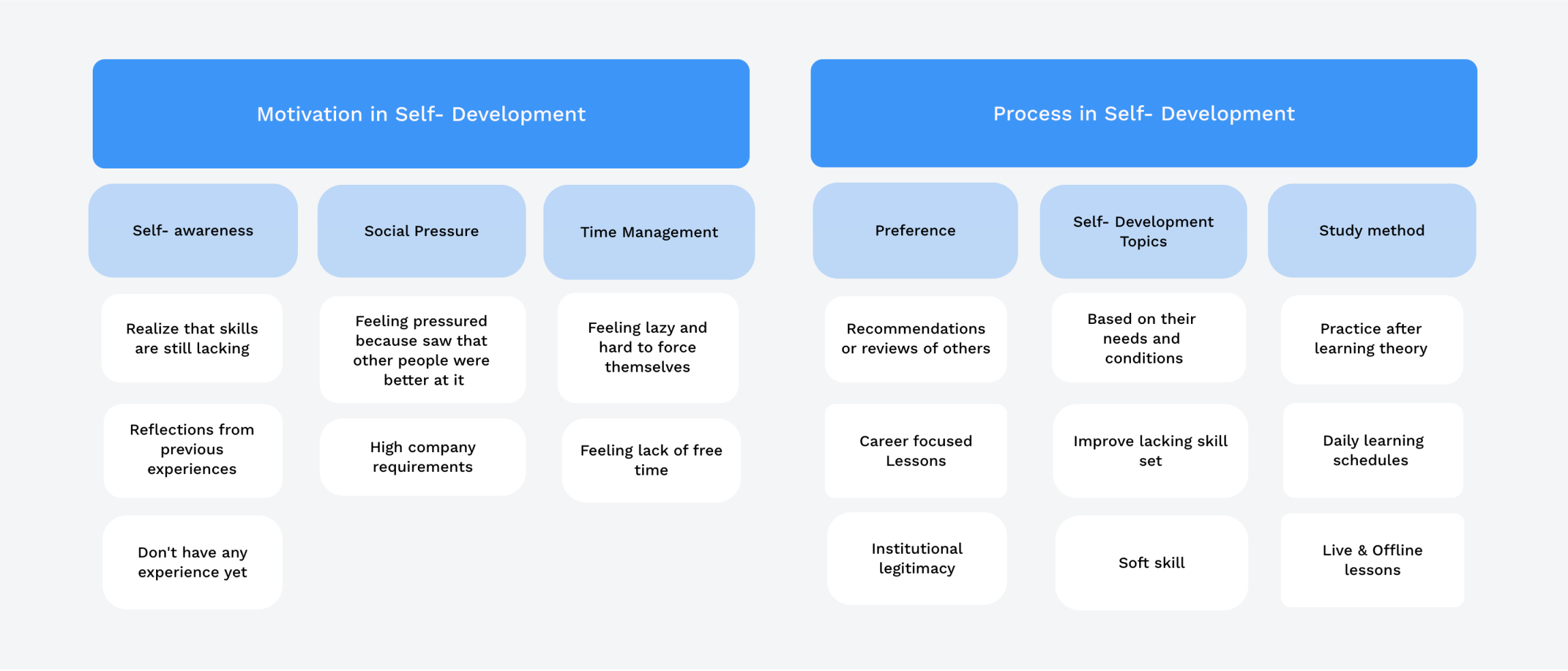
I created an affinity diagram by combining and grouping all the information I learned from the interview. I could see trends in my research more clearly, which aided me in making design decisions. My two key themes were Process Self-Development and Motivation in Self-Development.

Key Learnings

  1. Their motivation was affected by 3 factors, first self-awareness. Such as realizing their lack of skills and previous experience. Then the social pressure, which made them feel pressured and FOMO (Fear of Missing Out) because other people already got further. Lastly, time management. Feeling lazy and lacking free time could lower their motivation to develop their skill.

  2. The users had their own preferences when looking for a product that might help them to develop their skills, such as recommendations from others, Lesson timeline. They also picked self-development topics based on their needs and conditions. The method that they took to develop their skills were varied, mostly from video recording and live. They also tend to do practice after learning the theory.

Building empathy

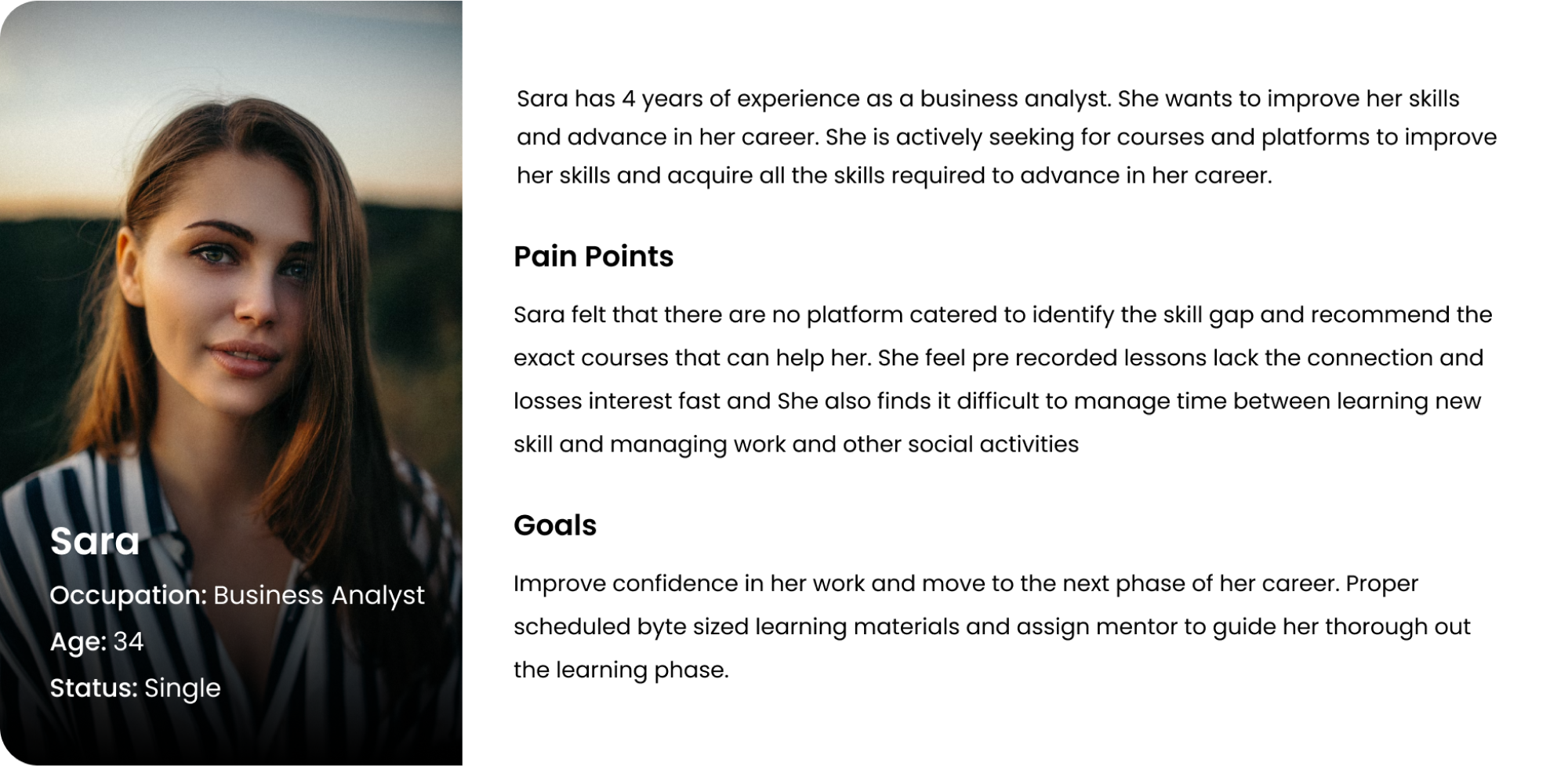
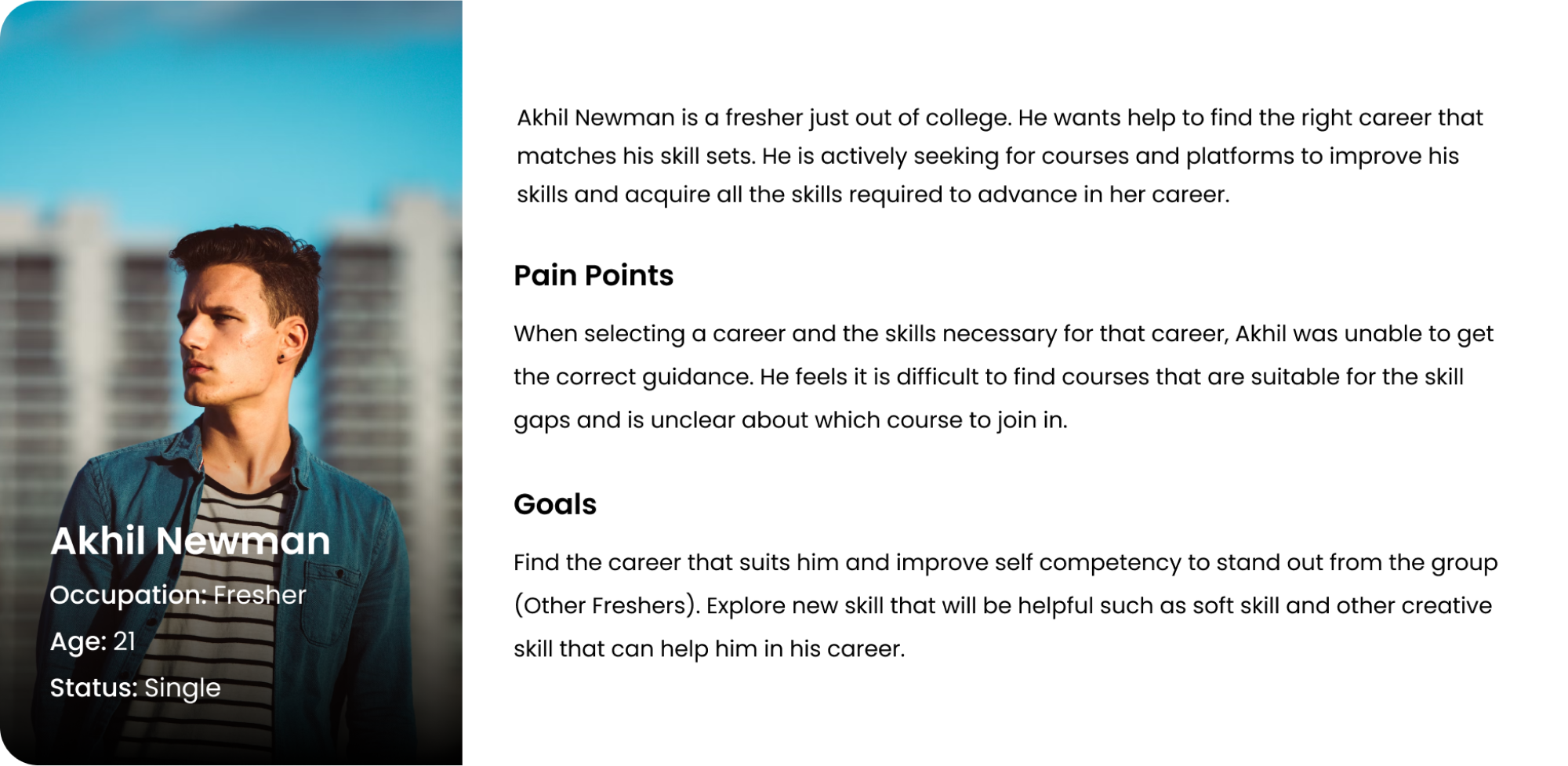
Using qualitative data based on the observations that I got from the interview. , I defined two persona Sara (Business Analyst, 34), Akhil Newman (Fresher, 23) to better empathize with my main user groups and prioritize goals according to their needs.

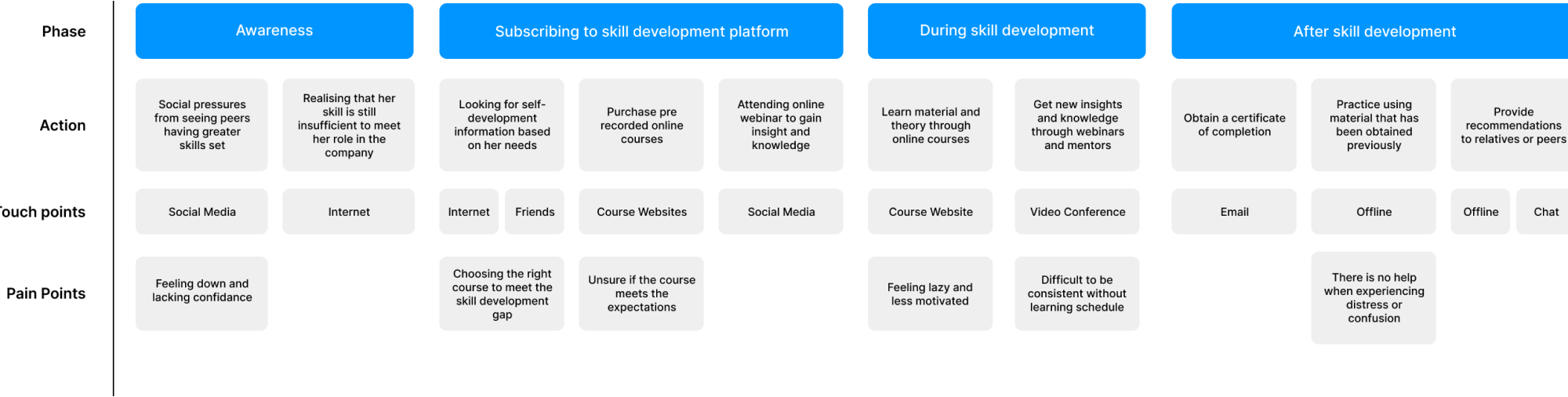
User Journey

These findings came from a previous conversation with participants about their experiences developing their abilities. Based on her circumstances, Sara aimed to improve her talents in order to pursue her desired career. Therefore, her actions were carried out beginning with awareness of the need for increasing abilities, followed by the purchase of products such as courses and webinars, completion of those till receiving certifications, and then trying hands-on work.

Ideating Solutions

  1. Create an evaluation based on the user’s current role or the one they are attempting to move into. The user takes a brief multiple-choice assessment, and depending on the results, courses are suggested to them.

  2. Offer remotely accessible online courses in the form of video recordings. Users are also more suited for learning to utilize video online as they can be viewed again at any moment, according to the journey map. Along with the video lessons, I also made the choice to provide the platform webinar and mentor features.

  3. Then, further scheduling features must be included so that users or businesses may build schedules (for instance, daily 10-minute learning sessions), which can lower dropout rates and improve time management.

Experience Mapping

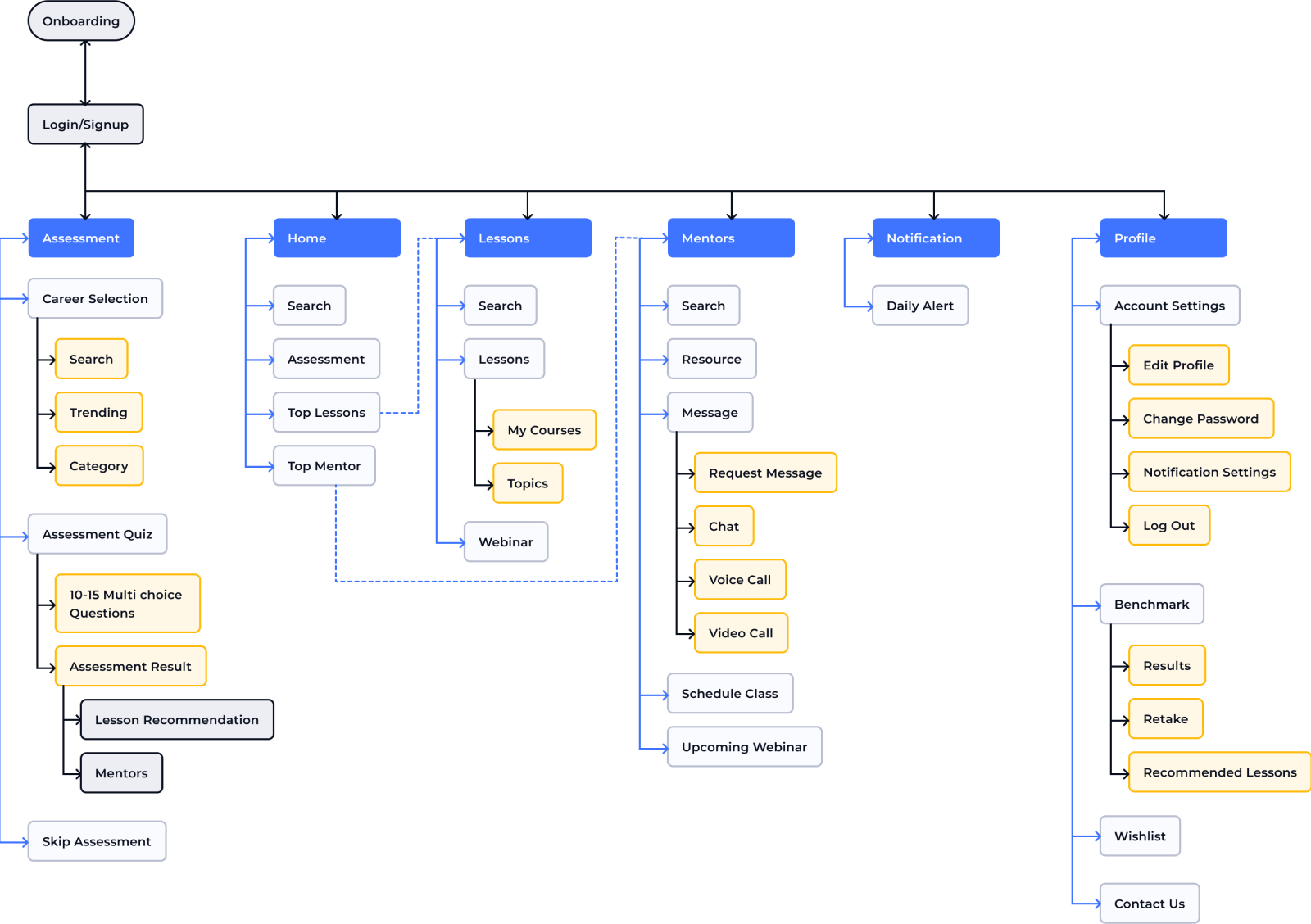
After having a solid grasp of the solution to be developed, I began to create the experience map. It was a combination of information architecture and user flow, which describes the information structures and workflows in the application. This method is quite efficient because I could quickly get a broad overview of the application. So that later it will help me on crafting the Hi-Fi design.

What did we improve

Micro Lessons

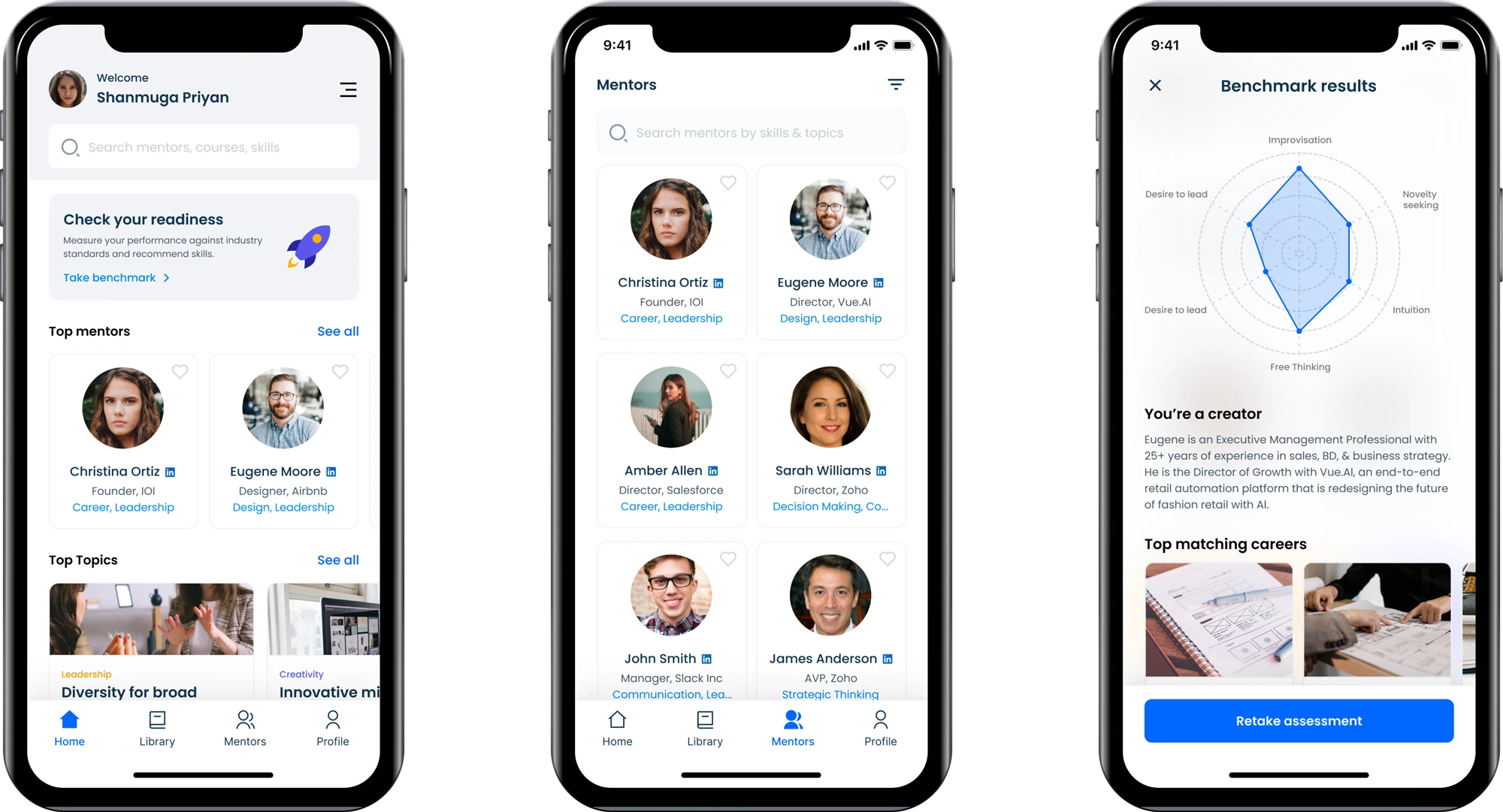
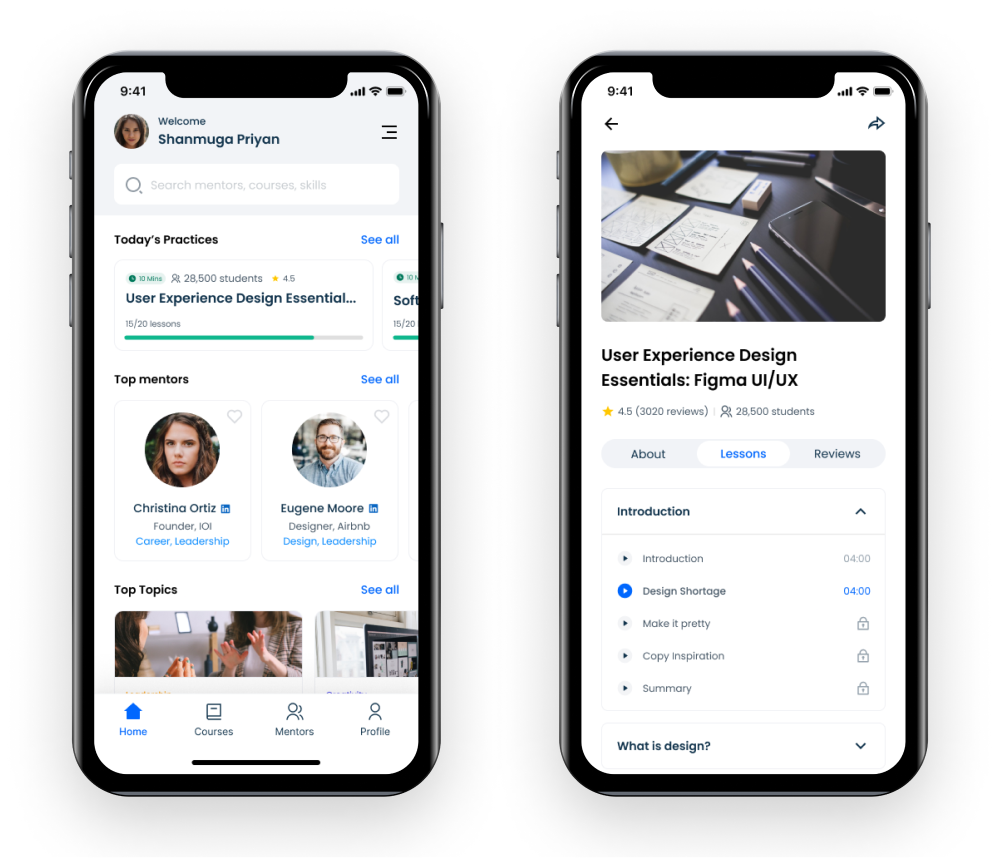
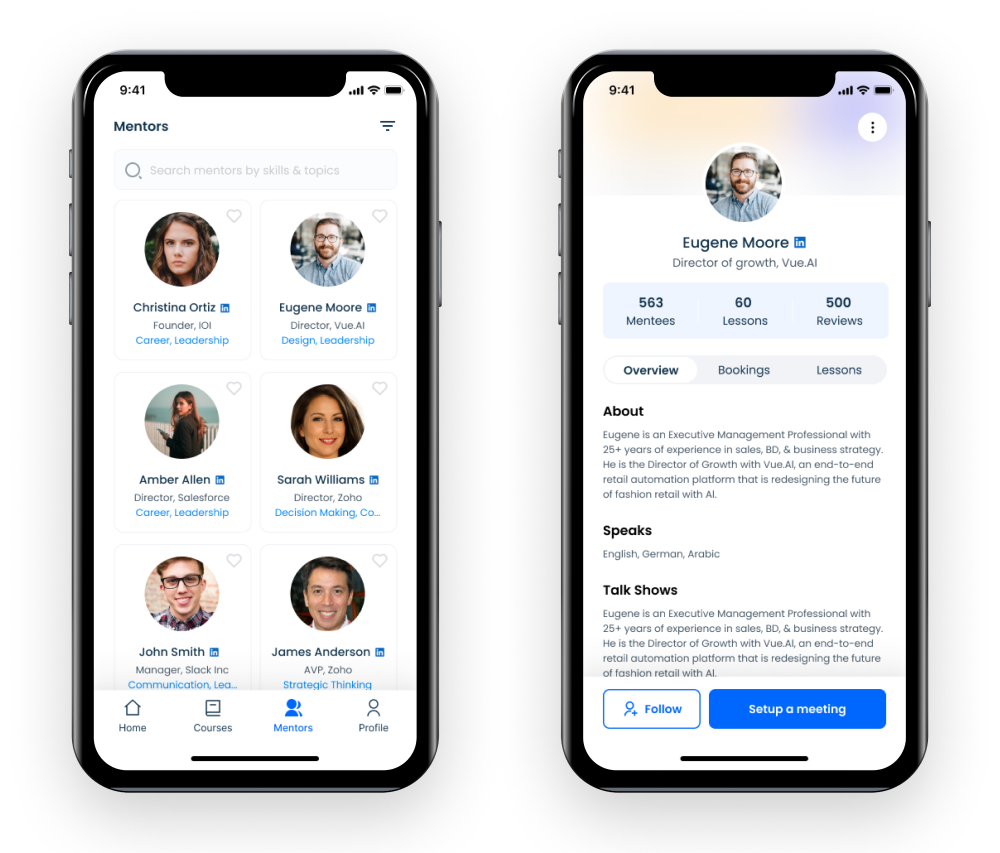
Gleac provides micro-lessons that are only 10 minutes long, and users can configure their study time to learn at their own pace. Gleac has a library of its own lessons, and organizations can also add their own lessons to Gleac.

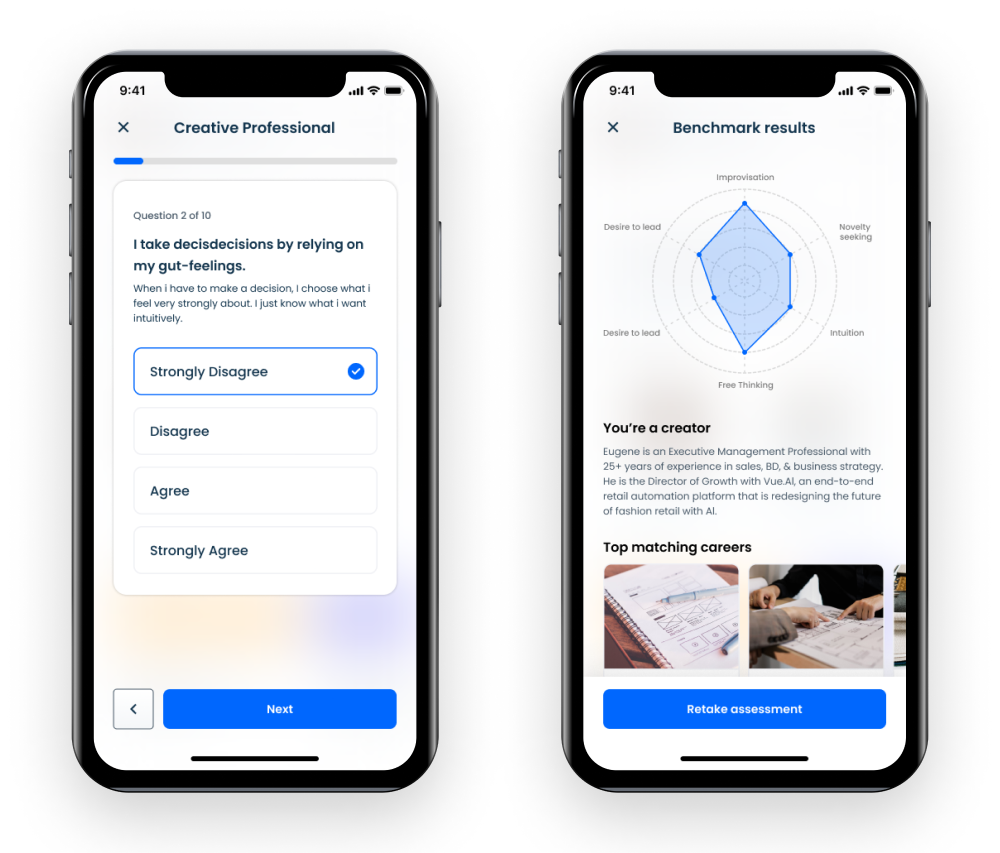
Skill assessment test

After assessment based on the performance of the use Gleac’s AI find the areas for improvement and suggest course for the users This feature helps users to bridge their skill gaps and achieve their career goals.

Mentoring

Users can begin setting up meetings with mentors once the invitation has been accepted. By using the video call, recording, and chat, users can stay in touch with their mentors during the sessions. Users get access to all meeting-related artifact, including audio recordings, mentor-shared materials, and notes.


Course Recommendations

After assessment based on the performance of the use Gleac’s AI find the areas for improvement and suggest course for the users This feature helps users to bridge their skill gaps and achieve their career goals. Additionally, Gleac allows users to track their progress and measure their success, providing valuable feedback and motivation to continue their learning journey.

Measuring Impact

After the launch of our skill assessment platform, we partnered with Prada to offer our services to their employees. Through our platform, Prada employees were able to assess their skills and identify areas for improvement. This partnership led to an increase in interest from other companies, and we were fortunate to be a part of Dubai Expo 2020.

As a result of these efforts, we have seen a significant increase in user engagement and have received positive feedback from our clients. 5+ enterprise organizations started using Gleac. We are excited to continue improving our platform and helping individuals and organizations achieve their career goals.